

Why We Built FIT
Every day brings new information.
Economic releases.
Company announcements.
Technology breakthroughs.
Political events.
Artificial intelligence.
Market narratives.
Financial markets rarely suffer from a lack of information.
They suffer from investigations that become fragmented across spreadsheets, charts, research notes, browser tabs, and increasingly, AI conversations.
The challenge is rarely finding another source of data.
The challenge is preserving the evidence, observations, and reasoning that keep the underlying thinking connected.
Financial Insight Tools did not begin as a software project.
It began as an attempt to simplify the way I investigated markets, investments, and economic developments.
Like many active traders and investors, I found myself moving constantly between market data, company reports, economic releases, handwritten notes, spreadsheets, and eventually AI. Each tool solved a particular problem, but none preserved the wider context as a whole.
Financial Insight Tools evolved from that experience—not to replace those tools, but to provide a structured environment where investigations remain connected as new evidence emerges.
The result is a modular investigation platform where observations, supporting evidence, and reasoning can be organised, revisited, expanded, and challenged over time.
What Is FIT?
Financial Insight Tools (FIT) is a modular investigation platform for exploring markets, investments, companies, economies, and the relationships that connect them through structured investigation. Investigations may begin from curated themes and catalysts, or directly from companies and business activities, before expanding into broader market exploration.
Individual modules can be used independently to answer specific questions, examine datasets, or investigate changing market conditions. They can also be combined into larger investigations where evidence, observations, and supporting context remain connected throughout the process.
As investigations develop, Financial Insight Tools preserves the continuity of the investigation. Observations remain linked to supporting evidence, investigations can be revisited as conditions change, and new information extends earlier reasoning rather than replacing it.
Once sufficient context has been assembled, AI can review the investigation, explore alternative perspectives, identify uncertainty, and contribute to structured interpretation.
The objective is not to replace the existing investigation with a new one, but to strengthen the evidence and reasoning already assembled.
Financial Insight Tools complements existing data sources, analytical software, and artificial intelligence by providing a practical environment in which investigations can be assembled, documented, revisited, and expanded as new information becomes available.
How FIT Is Organised
FIT is organised across six functional areas:
Discover — explore economic conditions, market opportunities, themes, catalysts, classifications and analytical frameworks to develop context for further investigation.
Relationship — examine relationships across assets, indicators, positioning, spreads, ratios, themes and macroeconomic conditions.
Examine — investigate market behaviour, volatility, company structure, market structure, timing conditions and price structure in greater depth.
Operate — structure proposed positions, apply portfolio-level controls, monitor active positions, review completed activity and examine programme-level costs.
Toolbox — apply focused calculations, diagnostics and data utilities where an investigation requires them.
Observation & AI Investigation — preserve investigation context, record observations and extend the investigation through portable AI context.
These areas do not impose a fixed sequence. They provide a structure through which an investigation can move according to the question being explored.
Discover → Relationship → Examine → Operate
Toolbox supports the investigation where required, while Observation & AI Investigation allows the developing context to be preserved, assembled and extended through AI-assisted review.
The route follows the question.
The Investigation Workflow
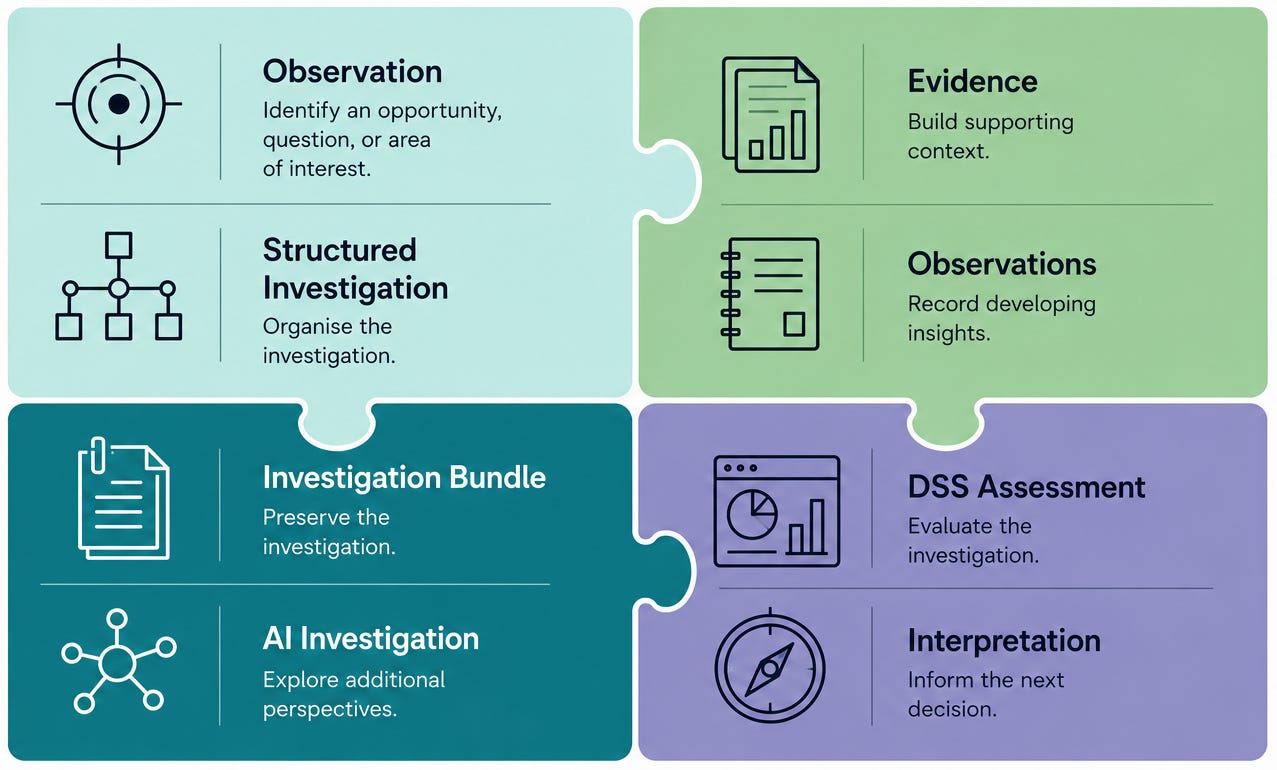
Every investigation begins with an observation.
That observation may originate from a company announcement, an economic release, a change in market behaviour, or simply a question worth exploring.
Financial Insight Tools provides a structured environment in which that initial observation can develop through curated themes, investigation pathways, business relationships, and supporting evidence into a connected investigation.
Rather than prompting AI with isolated questions, FIT preserves the investigation as a connected body of work. AI is then introduced as a reviewer of that investigation, helping explore alternative perspectives before the Decision Support System (DSS) Assessment summarises the current state of the evidence.
The investigation does not end with AI.
It remains available to revisit, expand, and reassess as new information becomes available.
Inside Financial Insight Tools
A selection of investigation surfaces from across the Financial Insight Tools environment.
Financial Insight Tools brings together a collection of connected investigation environments. Each module contributes a different perspective, allowing evidence, observations, and reasoning to develop within a consistent analytical framework.
Some modules answer specific questions. Others organise investigations, preserve observations, or provide additional market context. Together, they support investigations that can be revisited, expanded, and reviewed as new information becomes available.
Financial Insight Tools Launcher
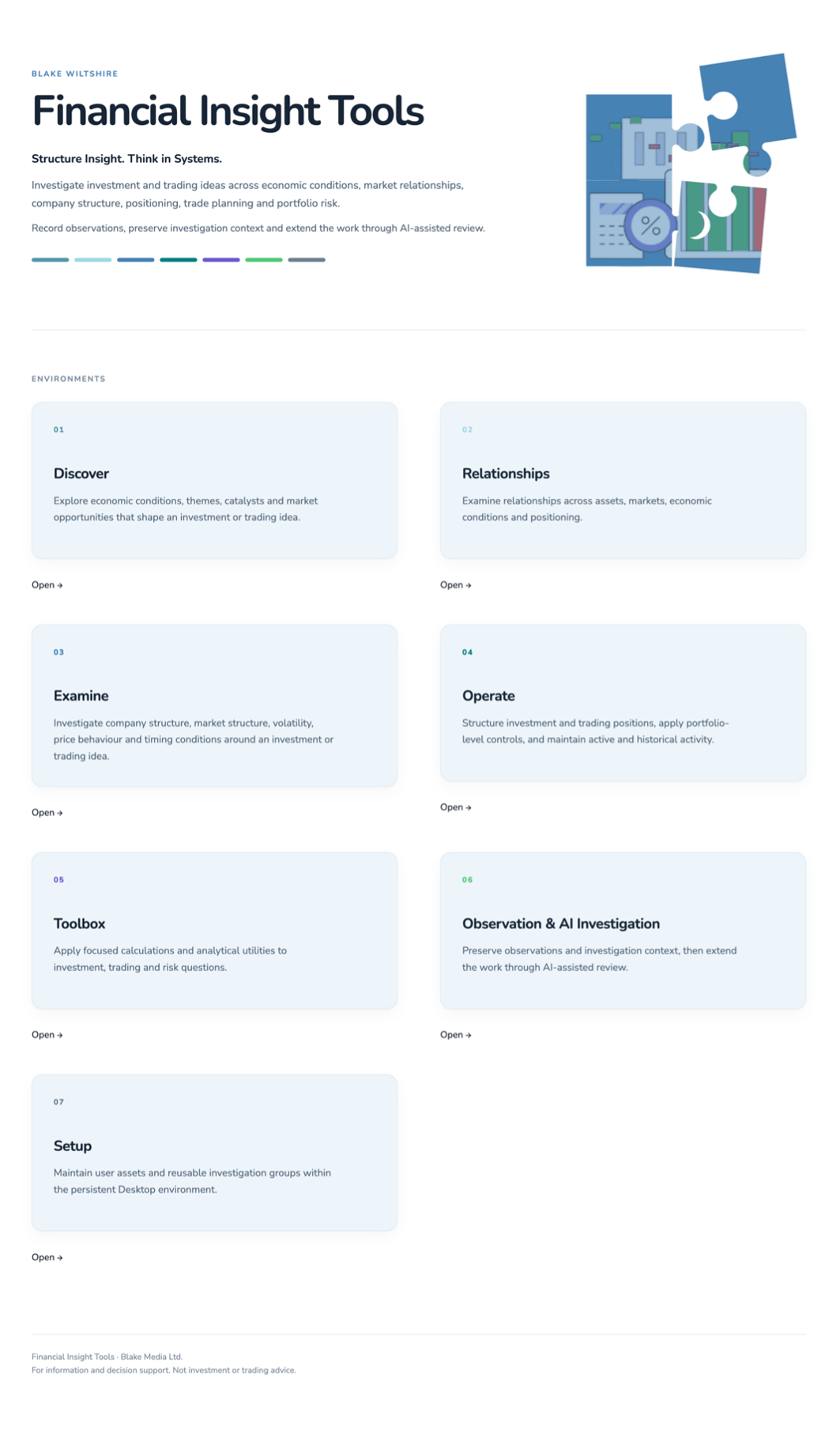
Install → Launch → Investigate
The launcher provides a structured entry point into Financial Insight Tools, bringing together macroeconomic exploration, market analysis, company analysis, observation workflows, and AI-assisted investigation within a single environment.
Discover
Economic Explorer
Economic Explorer provides structured access to macroeconomic indicators, thematic relationships, and Decision Support Snapshots that place markets, companies, and broader developments within an economic context. Individual use cases can be explored independently or combined as investigations develop.
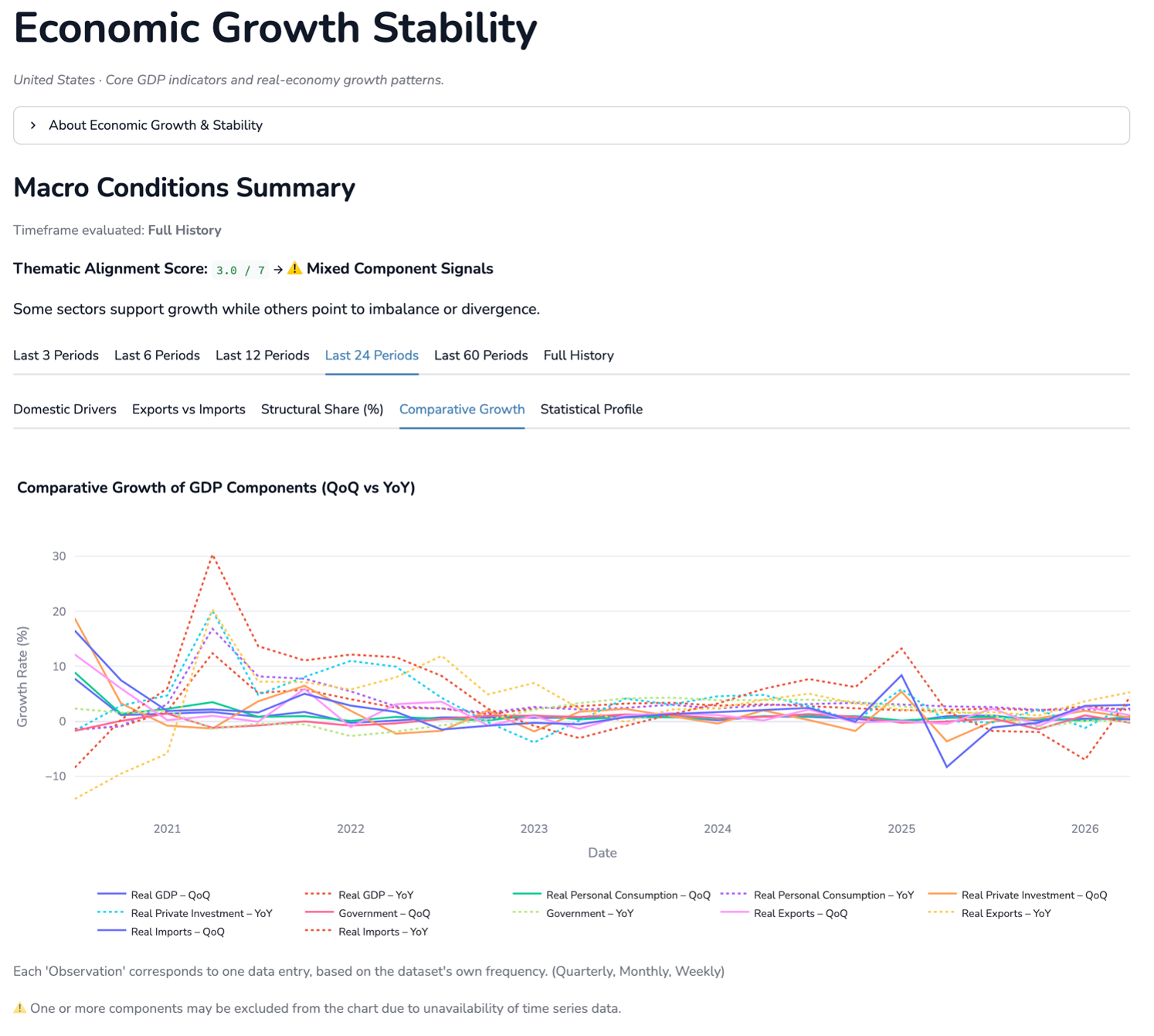
Observe → Discover → Widen → Focus → Investigate
Themes, Ideas & Catalysts
Themes, Ideas & Catalysts provides a structured starting point for developing observations into broader investigations. Curated Economic, Business, and Structural Themes expand through investigation pathways before Relationship Manager develops those pathways into business relationships, representative companies, and candidate assets for further examination.
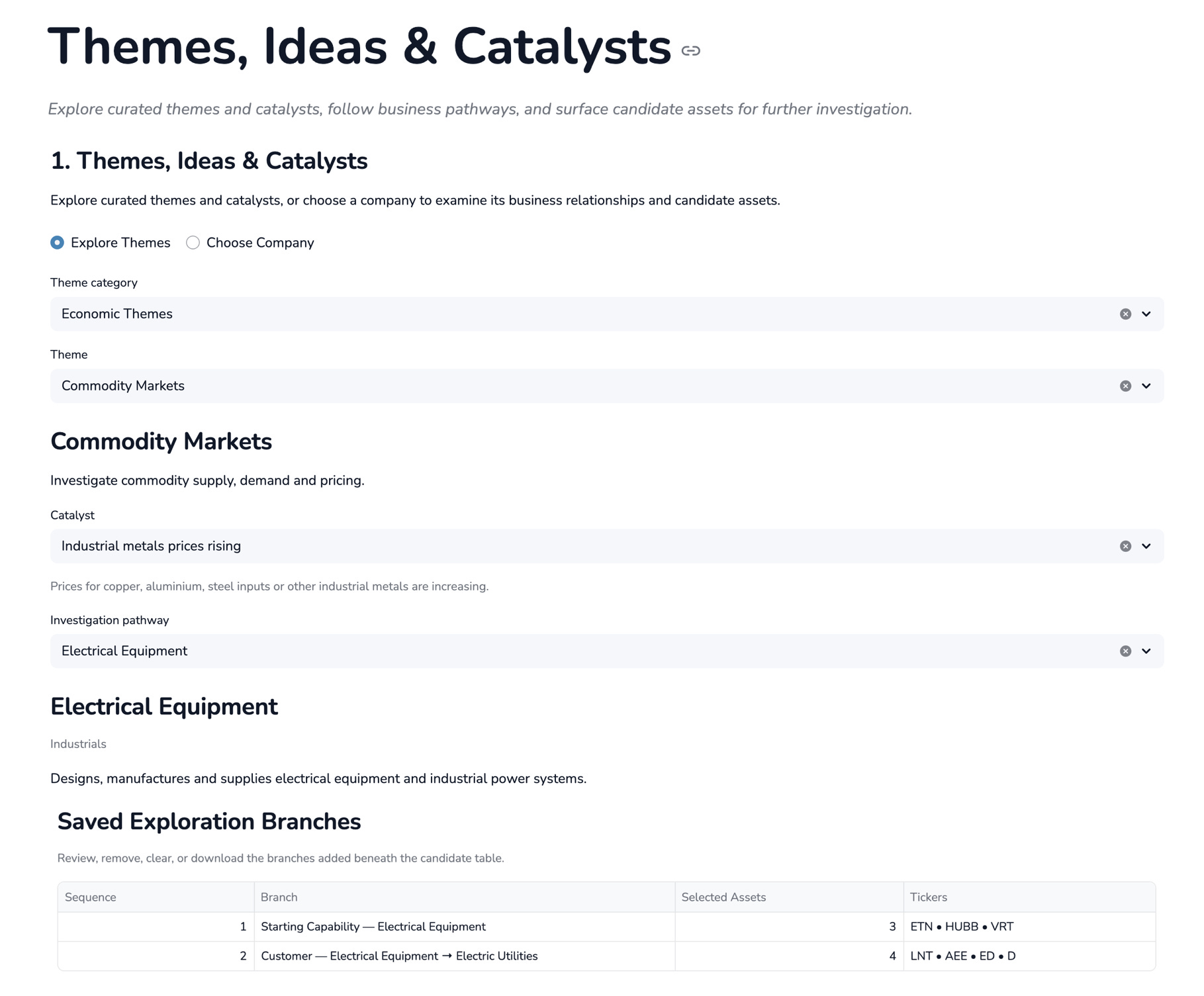
Observe → Discover → Widen → Focus → Investigate
Examine
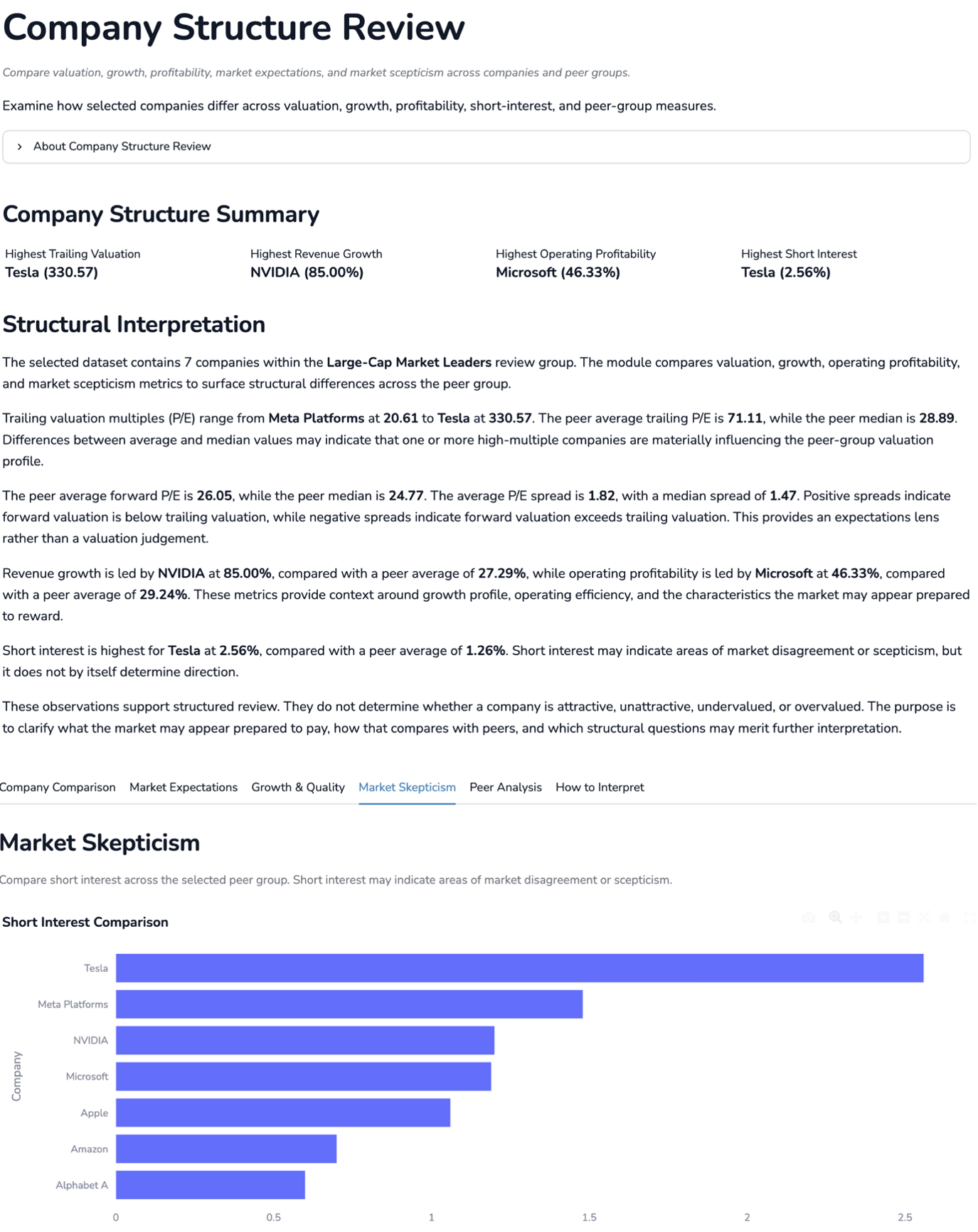
Company Structure Review
Company Structure Review compares valuation, growth, profitability, operating performance, and market sentiment across peer groups and individual businesses. Structured summaries and supporting observations provide context for relative strengths, structural differences, and questions that may warrant deeper investigation.
Focus → Examine → Test → Refine → Structure
Relationship
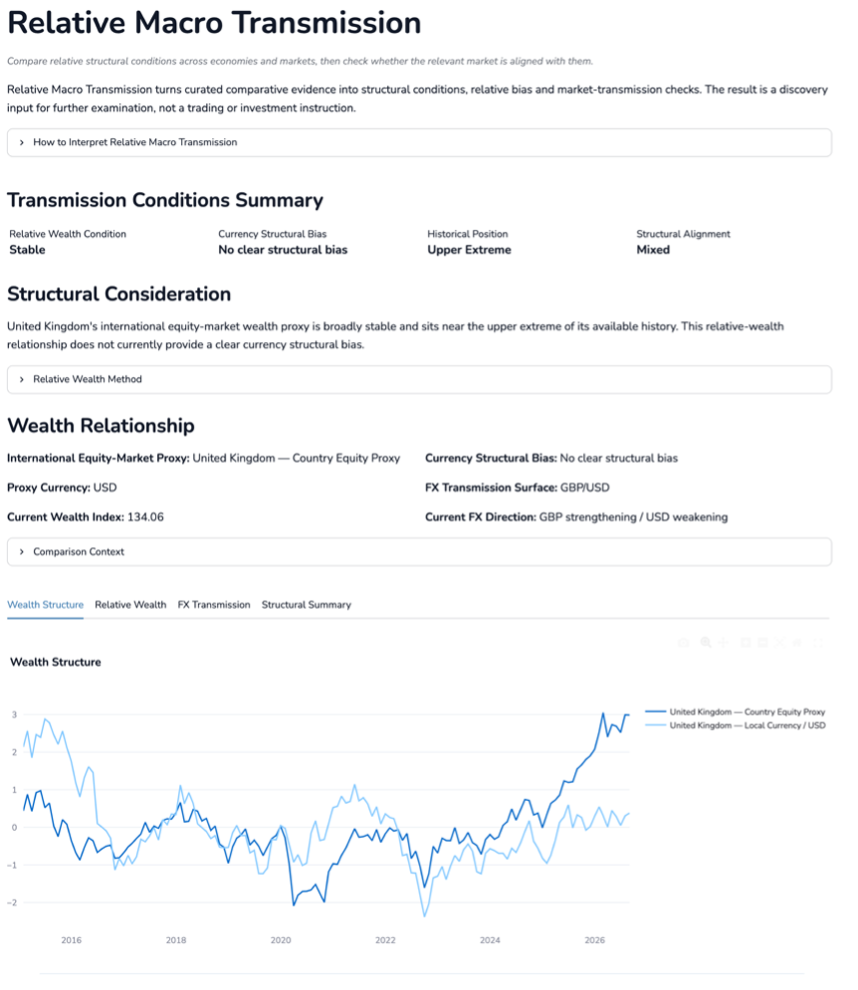
Relative Macro Transmission examines constructed relationships between economic and market series to investigate how differences in economic conditions can appear through relative market behaviour.
Transformations including differences, ratios, relative percentage change, relative Z-scores and rolling correlation provide different perspectives on how those relationships develop through time.
Connect → Compare → Test → Interpret → Examine
Operate
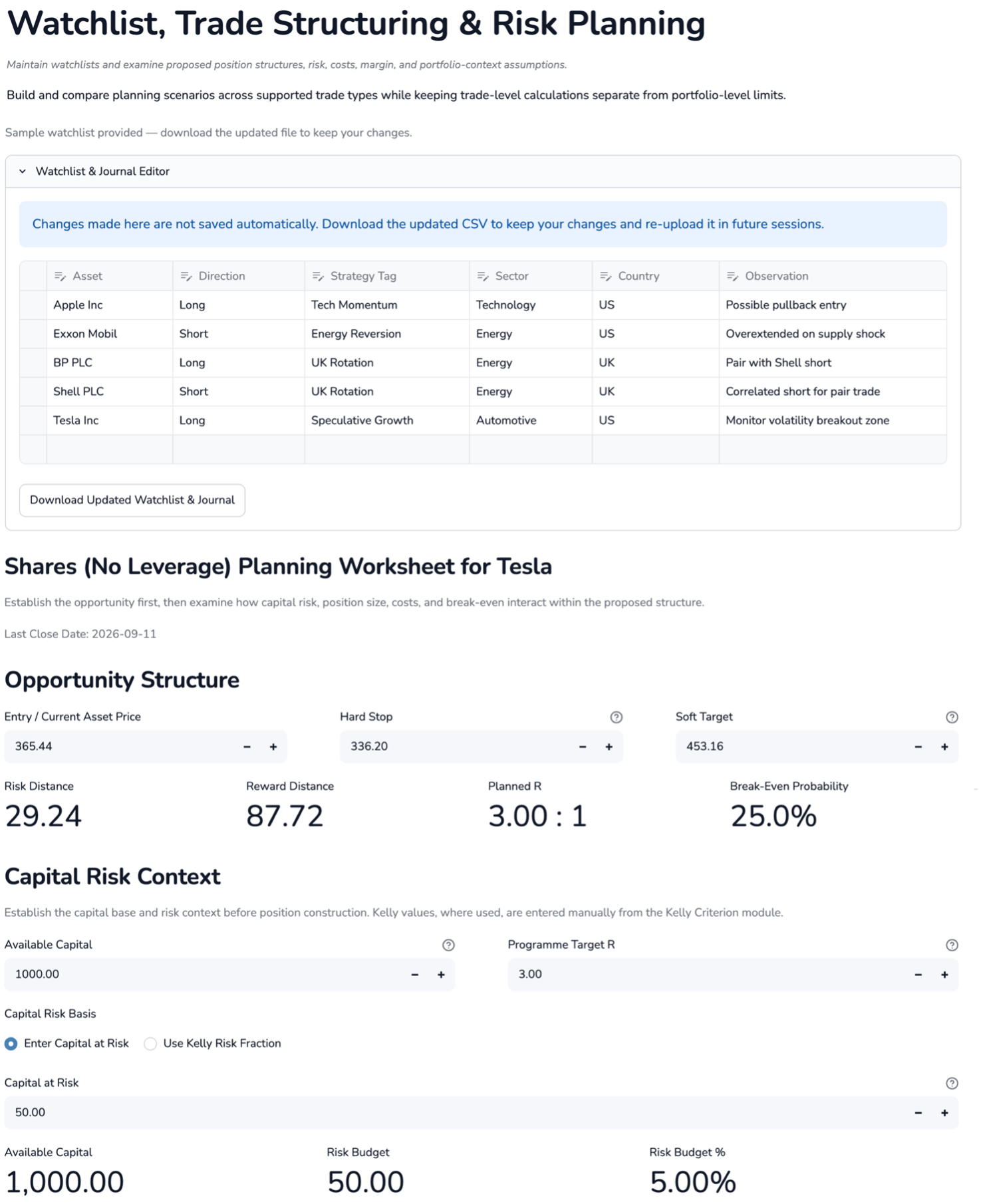
Watchlist, Trade Structuring & Risk Planning
Watchlist preserves candidate assets, supporting observations, and investigation context as new evidence becomes available. Existing investigations evolve through time rather than being restarted from the beginning.
Trade Structuring & Risk Planning translates investigations into structured planning assumptions. Position sizing, risk parameters, reward targets, execution costs, and planning notes are brought together within a single worksheet, allowing scenarios to be reviewed before decisions are taken. Structured planning remains connected to the wider investigation rather than existing as an isolated calculation.
AI
Observation & AI Investigation
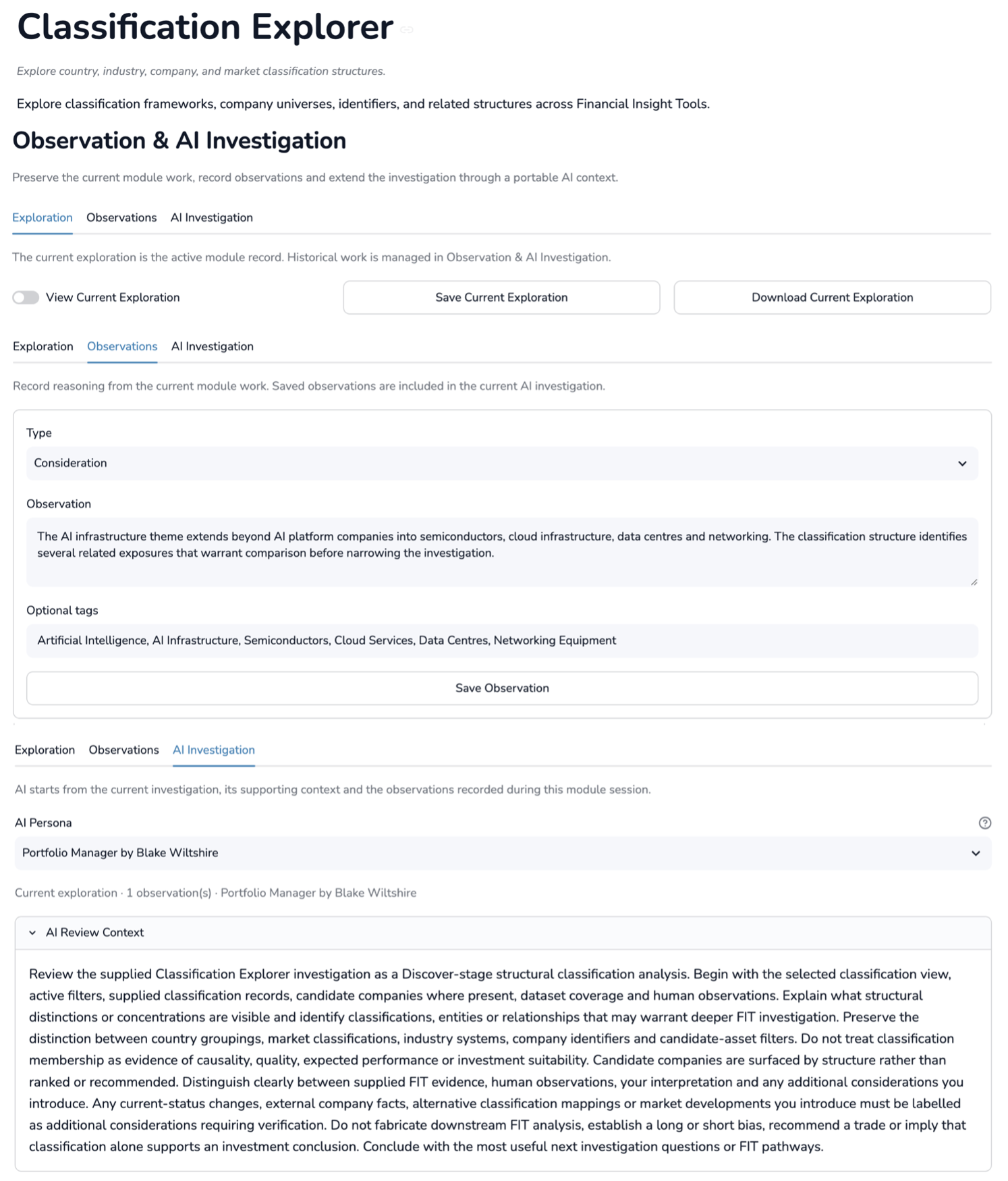
Observation & AI Investigation assembles preserved work into portable AI context and a structured investigation bundle.
Decision Support Snapshots, observations, research notes, statistical outputs, contextual metadata and AI persona instructions are combined into a connected body of evidence for review.
The AI Investigation surface then allows a selected persona to review that assembled context, explore uncertainty, challenge observations and support further interpretation without replacing the underlying investigation.
Because the context is bundled, the investigation is not tied to a single AI interaction or provider. It can be reviewed alongside FIT, preserved for later investigation, or carried into a compatible external AI environment while retaining the structure established inside the application.
Investigate → Observe → Preserve → Assemble → Continue
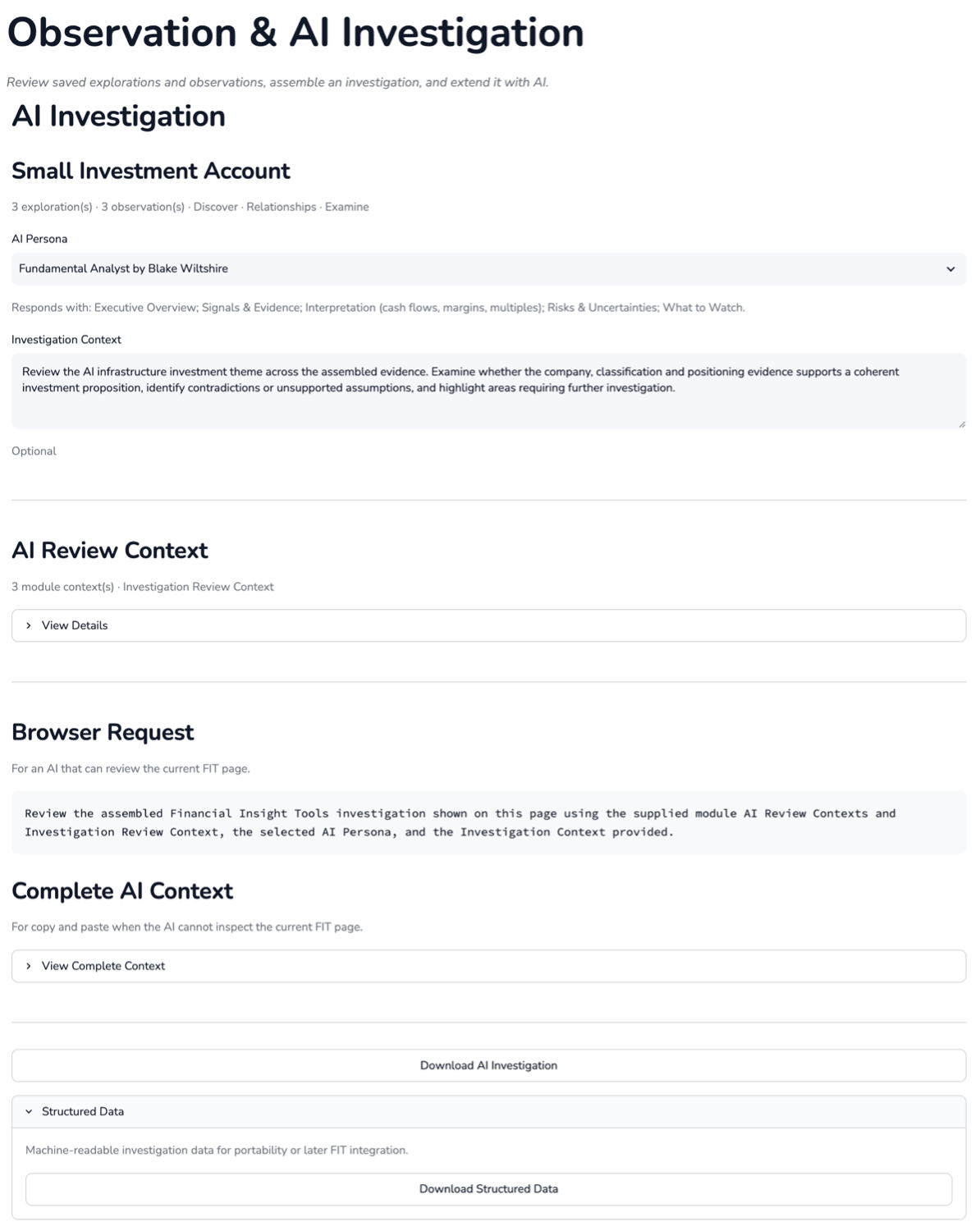
Preserve → Assemble → Contextualise → Interrogate
AI Response
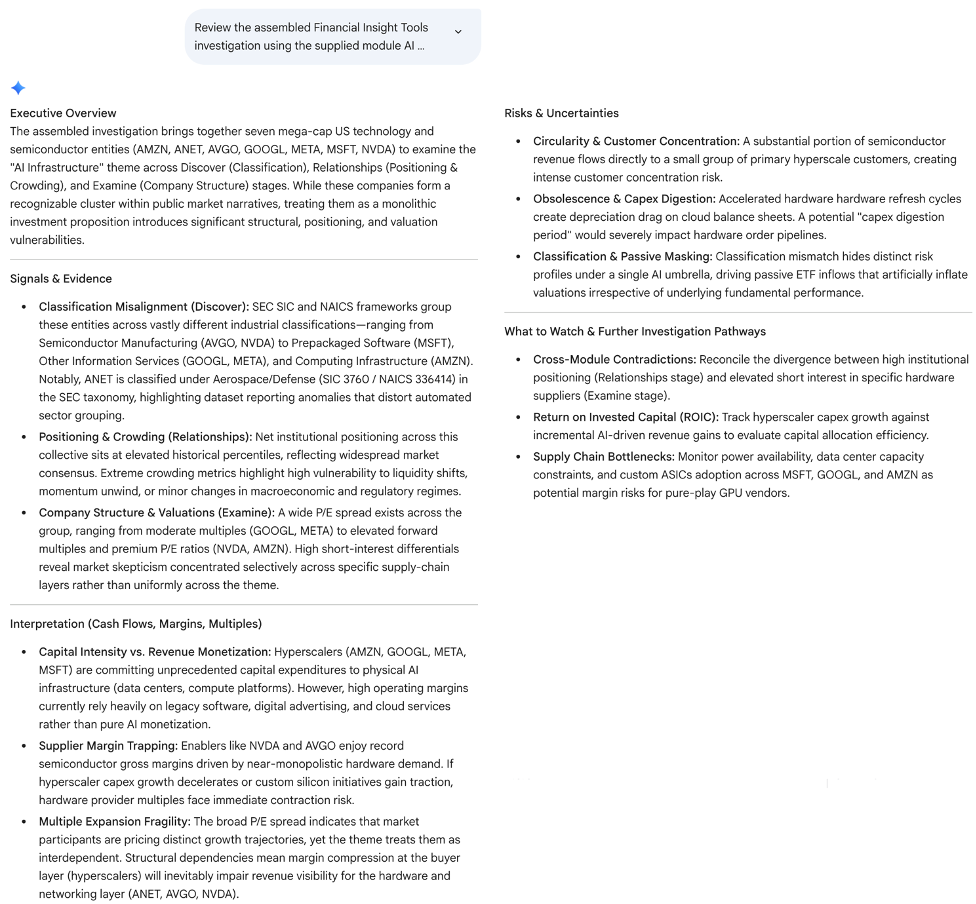
Review → Challenge → Reinvestigate → Update
Why Structure Matters
Artificial intelligence can produce remarkably capable responses.
The quality of those responses depends upon the quality of the investigation presented.
Financial Insight Tools preserves observations, supporting evidence, statistical context, and evolving reasoning within a connected investigation. Individual modules can be used independently to answer specific questions or combined as investigations develop. There is no fixed path through the environment; investigations expand according to the questions being explored.
As the investigation develops, evidence, observations, and reasoning remain connected rather than becoming isolated across multiple tools or conversations.
Once sufficient context has been assembled, AI can review the investigation, explore alternative perspectives, identify uncertainty, and contribute to structured interpretation.
The investigation remains available to revisit, extend, challenge, and reassess as new information becomes available, preserving the continuity of the reasoning alongside the evidence itself.
A Wider Ecosystem
Financial Insight Tools forms part of a broader ecosystem exploring economics, financial markets, artificial intelligence, and digital resilience through structured reasoning.
The companion guides provide the underlying concepts and analytical frameworks.
The insights demonstrate those concepts through practical investigations and applied examples.
Financial Insight Tools provides the structured environment in which investigations can be assembled, documented, revisited, and explored over time.
Together, they create a connected ecosystem where ideas move naturally between reference material, structured investigation, practical application, and AI-assisted interpretation.
Final Thoughts
Technology continues to reduce the cost of producing information.
What remains difficult is preserving the evidence, observations, and reasoning that connect it.
Financial Insight Tools was built around a simple idea.
Investigations should not disappear once an answer has been reached.
They should remain available to be revisited, challenged, expanded, and viewed from different perspectives as new evidence emerges.
Structure provides continuity.
Evidence provides context.
Alternative perspectives provide challenge.
Artificial intelligence becomes most valuable when it strengthens an investigation rather than replacing it.
Observe.
Investigate.
Preserve the evidence.
Invite alternative perspectives.
Decide with agency.
Related Exploration
Structure Insight. Think in Systems.
Explore Guides, Tools and Insights → blakewiltshire.com